
- Key Takeaways
- Notary vs. Commissioner
- Why Choose a Notary Lawyer in Alberta?
- Specialized Lawyer-Notary Services
- The Alberta Legal Framework
- The Digital Notary: Modern Practices
- Utilize secure digital platforms for remote notarization and electronic document handling.
- Offer virtual appointments and online consultations for client convenience and accessibility.
- Ensure digital notarization complies with Alberta’s legal standards and regulatory requirements.
- Maintain robust cybersecurity measures to safeguard client data and document integrity.
- How to Prepare Your Documents
- Gather all necessary paperwork, identification, and supporting materials before your appointment.
- Complete forms accurately and leave signature sections blank until witnessed by the notary.
- Review document requirements for specific legal purposes, such as immigration, real estate, or court filings.
- Create a checklist with comprehensive description to outline the necessary paperwork and procedures prior to an appointment with a notary.
- Conclusion
- Frequently Asked Questions
- What is the difference between a Notary Public and a Commissioner for Oaths in Alberta?
- Why should I hire a notary lawyer in Alberta?
- Which documents can a notary lawyer handle in Alberta?
- Are digital or remote notarizations allowed in Alberta?
- How do I prepare for a notary appointment in Alberta?
- Can an Alberta notary certify documents for use outside Canada?
- How much does notarization cost in Alberta?
Key Takeaways
- Get to know the roles in Alberta. Notaries public may notarize documents for use inside and outside Alberta, but commissioners for oaths are restricted to documents used within the province. Select a notary public for international, real estate and statutory declaration services.
- Think of a notary lawyer for an extra legal shield. Lawyer-notaries merge legal expertise with notarization, providing assurance that your documents meet Alberta law and minimize the chances of refusal or conflict.
- Put risk reduction and document sanctity first. A notary lawyer confirms identities, avoids mistakes, maintains documentation and observes formalities that safeguard against fraud and preserve enforceability.
- Design it internationally. For documents going abroad, a notary lawyer can take care of apostille or legalization steps, coordinate with foreign requirements and facilitate cross-border transactions.
- Use specialists for the tough stuff. Lawyer-notaries simplify real estate, corporate, wills and estates, and affidavit procedures by organizing participants, fulfilling regulatory requirements, and providing expert advice.
- Plan ahead for your visit. Simply bring valid ID, fill out forms but do not sign and verify any special needs for immigration, property, or court filings so you’re not delayed.
A notary lawyer in Alberta is an Alberta lawyer who can notarize and commission documents under Alberta law while providing legal advice on relevant issues. In the province, notarial services include affidavits, statutory declarations, certified true copies, consent letters, and real estate or corporate documents. Fees diverge by firm and document type, with many firms charging flat fees for single-page notarizations and higher fees for complex packages. You’ll need valid government ID, and documents must be signed in the lawyer’s presence. Alberta permits remote notarization with certain conditions, usually via secure video and identity verification. For costs and timing, our clients frequently inquire about rush service, translation, and if the notarization is accepted abroad. The guide below outlines each phase.
Notary vs. Commissioner

This is important when your documents travel internationally. In Alberta, a notary public and a commissioner for oaths both witness signatures and verify identity. Their legal authority and responsibilities differ.
Distinct Powers and Responsibilities
A notary public in Alberta has greater powers than a commissioner for oaths. A commissioner can administer oaths, affirmations, and statutory declarations for documents utilized in Alberta. A notary can do all that plus notarize documents for use inside and outside Alberta. That additional jurisdiction is crucial when a bank, court, or agency in another province or country requests notarization.
- Check identity with a valid government ID and screen for voluntariness and comprehension.
- Take acknowledgments, jurats (oaths to the truth), and certify copies.
- Notarize documents for use across Canada and abroad
- Review documents for completeness and refuse improper requests
- Retain records in perpetuity and use a notarial seal that is recognized beyond Alberta.
- Take care of cross-border forms, consents, and corporate records needing notarization.
Notaries are the norm in most countries, including the US. Almost all U.S. Transactions that require a witnessing third party or sworn statement require a notary, not a commissioner. US notaries undertake state-mandated training, maintain detailed journals and carry out a prescribed set of acts such as acknowledgments, jurats and copy certifications. States control fees, generally around USD 2 to 15 a signature, and permit travel or after-hours fees. Penalties for misconduct can range from fines of up to USD 10,000, loss of commission and even criminal charges. These controls establish a standard that foreign recipients depend upon. Commissioner of oaths, popular in Canadian provinces and some other commonwealth countries, has little or no standing in the U.S., where a commissioner of deeds is limited to administering oaths and affirmations.
When You Need a Notary Public Instead of a Commissioner
Pick a notary when the document is going to be utilized outside Alberta. For example, U.S. Immigration papers, cross-border POAs, or international school and employment records require a notary. Real estate deals with out-of-province lenders, corporate filings for foreign registries, or a consent to travel that a foreign border agent will review require a notary. For statutory declarations that will be filed in another province or in the U.S., use a notary as many U.S. Bodies will not accept commissioner acts. When in doubt, ask the recipient which act they need and accommodate it to the notary’s jurisdiction.
Why Choose a Notary Lawyer in Alberta?
Notaries Public lawyers add legal analysis to a formality that might seem rote. This aid complies with Alberta’s regulations and reduces risk on personal, commercial, and immigration issues.
1. Legal Counsel
A lawyer-notary can identify problems as they arise, then modify wording or suggest actions prior to your signing. This is handy for affidavits, statutory declarations, separation agreements, or cross-border contracts.
They make certain forms comply with Alberta law so filings aren’t rejected by a court, regulator, or a foreign authority. Notaries Public in Alberta are appointed by the Court of Queen’s Bench pursuant to the Notaries Public Act and Notaries Public Regulation. Many in Edmonton are lawyers who are regulated under provincial statutes.
They’re able to flag family law pitfalls, contract traps, or regulatory gaps. For powers of attorney and wills associated with Alberta property, a lawyer should draft or review them prior to any witnessing or certification by a notary.
2. Risk Mitigation
A lawyer-notary avoids mistakes that void documents, such as forgotten exhibits, erroneous jurat dates, or improper ID verification. They consult on secure data and business secrets. For high-stakes files, such as commercial leases, share deals, or real estate, they construct measures that reduce risk. They further attest to identity and capacity pursuant to the Alberta Evidence Act and similar rules, which enables court and regulator acceptance.
3. Document Integrity
They verify signatures, seals, and content so documents stand up to review. They notarize true copies and originals for court filings, immigration packets, or corporate records. They maintain records according to Notaries Public Regulation and Law Society of Alberta direction, adding accountability. Seals and formalities secure against fraud or post-sign tampering.
4. International Validity
Why select a notary lawyer in Alberta? They handle apostille and legalization workflows and monitor consulate processes and times. This facilitates immigration, cross-border sales, and purchases of property while remaining within Canadian and international frameworks.
5. Complex Transactions
They do land transfers that connect to the Land Titles Act (Alberta), such as affidavits to support registration in Edmonton and elsewhere. They juggle agents, lenders and government offices to keep closings and filings on schedule. They handle powers of attorney, personal guarantees and shareholder disputes, along with corporate requirements such as certified copies and notarized signatures on contracts. Charges vary by work and location, from modest to a few hundred dollars.
Specialized Lawyer-Notary Services
Specialized Lawyer-Notary Services
Professional full-service lawyer-notary support in Alberta servicing your real estate, corporate, family, and immigration needs. There are many Alberta notaries, most of whom are lawyers appointed by the Court of Queen’s Bench pursuant to the Notaries Public Act and the Notaries Public Regulation, which establish duties and standards. For wills or a power of attorney related to Alberta property, have a lawyer draft or review first, then a Notary can witness or certify. They charge by task and city, from small amounts to a few hundred dollars.
Real Estate
Lawyer-notaries draw up and notarize purchase agreements, mortgage instructions, land title documents, and statutory declarations related to title insurance or residency.
They verify adherence to the Land Titles Act (Alberta) and local filing guidelines in Edmonton and beyond and confirm that forms, such as the Affidavit of Execution and Transfer of Land, are duly filled and sworn.
Lender, broker, realtor, surveyor and Land Titles office coordination to keep closings on time. Where required, they organize expedited registration or fix refusals.
My advice runs from boundary encroachments and right-of-way easements to personal guarantees for small-business borrowers, holdbacks for repairs, and tenant estoppel certificates in income properties.
Corporate Law
Specialized Lawyer-Notary Services lawyer-notaries notarize shareholder agreements, director resolutions, banking authorities, and key contracts so signatures and copies carry legal weight. They make certified copies of minute books or certificates for banks.
They back compliance checks, IP assignment submissions, and contract disputes and notarize statements for regulatory bids. For cross-border transactions, they authenticate identity, notarize true copies and advise on apostille or consular legalization as needed.
Strategic advice spans mergers and acquisitions, due diligence checklists, data-room affidavits, and notarized officer’s certificates in closings.
Wills & Estates
We notarize wills, codicils, trusts, and enduring powers of attorney after lawyer drafting or review when property is involved to minimize the risk of challenge and comply with Alberta rules.
Services are guided by probate applications, estate grants, and post-grant transfers with sworn affidavits of service and execution for court.
They draft and notarize affidavits of execution and survivorship, coordinate witness requirements, and attest to capacity and voluntariness. Families receive clearer intent, cleaner filings, and fewer delays.
Affidavits
Prepare and notarize affidavits for civil suits, family claims, and immigration appeals with well-articulated facts, exhibits, and accurate jurats. Requirements adhere to Alberta’s Evidence Act and court practice notes, with proper venue, dates, and commissioner information. Identity verification utilizes government identification and in-person or authorized remote witnessing where allowed. They keep records confidential, error-free, and filing ready.
The Alberta Legal Framework
Alberta makes a distinction between notaries public and commissioners for oaths under the Notaries and Commissioners Act, the Notaries Public Regulation, and the Commissioners for Oaths Regulation. Notaries have wider authority, such as notarizing documents for use outside Alberta, while commissioners operate inside Alberta and predominantly for Alberta purposes. The Law Society of Alberta governs lawyers who are notaries and establishes conduct and discipline standards that reflect the public interest.
Regulatory Duties
Notaries are required to maintain a bound or electronic journal recording the date, type of act, parties, identification reviewed, and document references. They stamp an official embossing seal with the notary’s name and the words Notary Public and Province of Alberta, and they keep copies of notarized pages when permitted by law to do so.
They adhere to Alberta Government appointment policies that encompass eligibility, term limits, and renewal timing. Services must be delivered in a manner that is equitable, transparent, and in accordance with access to information and privacy legislation.
Compliance involves the Notaries Public Regulation, the Alberta Evidence Act, and any industry regulations associated with the document, such as real estate or immigration. Lapses can void a paper or incite grievances.
Clients need to know why something should be notarized, what notarization attests to, and the boundaries of this function. For instance, a notary verifies identity and signature, not the veracity of the document.
Identification Rules
All signers provide government-issued photo ID, such as a passport or driver’s license. In cases where the names vary between documents, supporting documentation, like a marriage certificate, is examined.
Verification follows the Alberta Evidence Act: confirm likeness, match signatures, and check expiry dates. Remote or electronic notarization, where allowed, applies secure video, tamper-evident technology, and audit trails.
We keep records of IDs shown, type, and number. Storage meets security and retention timelines.
Service is refused if ID is absent, inconsistent, or fraudulent. For instance, a foreign passport and Canadian work permit bearing different names.
Confidentiality Mandates
Notaries and lawyer-notaries are obliged to maintain client confidentiality under statute and professional codes. This encompasses drafts, IDs and personal information transmitted to fulfill a notarization.
File access is role-based with need to know controls only.
Paper files are secured in locked cabinets and digital files are encrypted, backed up and access-restricted. E-signatures are readily accepted in Alberta, and integrity, audit and secure retention are still key.
The Digital Notary: Modern Practices
Digital workflows now sit beside Alberta’s venerable in-person notarization. The objective remains to validate identity, ensure intent, and safeguard the record, but tools have evolved to suit worldwide remote-first demands.
Utilize secure digital platforms for remote notarization and electronic document handling.
Remote online notarization (RON) shifts the in-person notarization session to a secure platform that facilitates live video, identity proofing and e-signing. The video call replicates the face-to-face check that has mentored legal documents for generations, while audit trails and tamper-evident seals secure the completed file. In practice, a client uploads a passport, executes some knowledge-based checks, participates in a video call, signs on screen and within minutes gets a sealed PDF. They employ encrypted storage, multi-factor login, and auto-backups to monitor versions and protect files end to end. More than 70% of Canadian firms now deploy these remote tools, frequently exhibiting 30 to 60% quicker turnaround.
Offer virtual appointments and online consultations for client convenience and accessibility.
Your clients book time zones effortlessly, eliminate trips, and sign from home or office. That benefits cross-border professionals, caregivers, and rural residents who can be hours from a notary. In COVID-19, these alternatives moved from ‘nice to have’ to essential, driving widespread adoption. Popular use cases are statutory declarations, real estate addenda, and corporate resolutions. A well-defined intake flow, including ID upload, conflict checks, fee quote, and a test call, makes the session go smoothly and reduces do-overs.
Ensure digital notarization complies with Alberta’s legal standards and regulatory requirements.
Different rules apply by province. Alberta is one of the most flexible, allowing permanent remote signing for estate documents, while Ontario maintains stricter restrictions. There are things that require in-person wet ink, like trusts, single status affidavits and negotiable instruments. Alberta notaries and lawyers verify the client’s identity, maintain videos, affix electronic seals that comply with provincial tech standards, and provide certificates that indicate remote processes. Firms identify cross-jurisdictional problems when a signer is based outside Alberta.
Maintain robust cybersecurity measures to safeguard client data and document integrity.
They employ TLS 1.2 or higher encryption, role-based access, and multi-factor login. When possible, store files on servers in Canada to make data residency a little easier. Perform vendor due diligence, execute quarterly patch cycles, and maintain incident response plans. Instruct employees to identify phishing attempts and configure quick link expirations on files shared. Combine platform audit logs with retention schedules that align with Alberta’s professional rules.
How to Prepare Your Documents
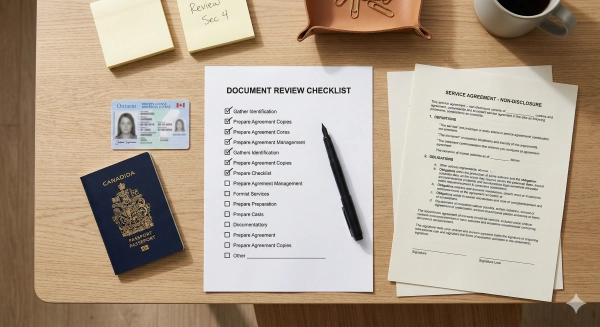
Gather all necessary paperwork, identification, and supporting materials before your appointment.
Bring the complete, final version of the document, any exhibits or schedules, and the precise instructions from the receiving office. Other offices require two new IDs, a wet-ink signature, or prohibit outside witnesses. Expect two forms of legitimate, government-issued ID such as a passport and a driver’s license. If the document is going abroad, check if you require certified true copies of IDs, POA or a notarized translation. Notaries and commissioners in Alberta have to adhere to legislation for safe ID checks and record-keeping, so ensure you have originals prepared.
Complete forms accurately and leave signature sections blank until witnessed by the notary.
Type or print names as on your ID. Use the same format for your address everywhere. Complete with dates, locations, and reference numbers. Do not put your signature or initials in any field that reads ‘in the presence of’ or something along those lines. For sample cases, an affidavit for court, a travel consent letter for a minor, or a statutory declaration for a lost passport must be signed only when the notary or commissioner watches you sign. If the form requests a notary seal, do not scribble in that section.
Review document requirements for specific legal purposes, such as immigration, real estate, or court filings.
Immigration forms may demand two IDs, precise name matches, and a notary’s seal for a consulate. Real estate closings can demand wet-ink signatures and bar remote witnesses. Court affidavits will usually say who can commission and the wording of the oath. For foreign use, expect extra steps: notarize, then authenticate and legalize through the proper channels. Electronic signatures are good for a lot of things in Alberta, but some institutions still require wet ink, so double check.
Create a checklist with comprehensive description to outline the necessary paperwork and procedures prior to an appointment with a notary.
- Purpose and destination: Alberta-only (Commissioner or Notary) or foreign (Notary Public required).
- Receiving office rules include witness limits, wet-ink needs, a two-ID policy, and special forms.
- Identity: two valid IDs ready; names match the document.
- Document status: final text, no blanks, attachments present, no pre-signing.
- Signature plan: in-person or e-sign; confirm acceptance.
- Extras: certified copies, translations, apostille/legalization steps, timelines.
- Logistics: booking time, fees, and return method for originals.
Conclusion
A notary lawyer in Alberta provides legal expertise in addition to the authority to notarize. That reduces time and reduces risk. You receive transparent reviews for identity, reach, and format. You receive guidance that suits Alberta regulations and court requirements. Digital tools inject speed for easy files. In-person assistance is available for transactions that require wet ink or a sworn oath. For cross-border work, a lawyer-notary walks you through steps like apostille or consular checks.
To move fast, set a short list: file list, valid ID, names and dates, and who signs what. One quick call secures fees and timing. For next steps, schedule a brief consult. Post your draft. Request a scope check. Make a quote and an appointment. Then sign in peace and evidence.
Frequently Asked Questions
What is the difference between a Notary Public and a Commissioner for Oaths in Alberta?
A Notary Public is able to verify identities, witness signatures, and certify true copies for use in and outside Alberta. A Commissioner for Oaths can take oaths, affirmations, and declarations only for documents to be used in Alberta.
Why should I hire a notary lawyer in Alberta?
Notary lawyer Alberta You receive document authentication as well as advice on legal hazards, adherence and next steps. This decreases mistakes, back and forth, and refusals, particularly for immigration, real estate, business and estate paperwork.
Which documents can a notary lawyer handle in Alberta?
Typical documents are affidavits, statutory declarations, certified true copy, power of attorney, consent letters, real estate forms and international documents. They draft and cross-check legal documents for correctness and approval.
Are digital or remote notarizations allowed in Alberta?
Yes, remote online notarization is allowed under Alberta rules when technology and ID verification standards are met. Your notary lawyer in Alberta will verify eligibility, platform terms and conditions, and if the receiving entity accepts digital notarization.
How do I prepare for a notary appointment in Alberta?
Bring government photo ID, unsigned documents, and any directions from the receiving party. Double check that names match your ID. If witnesses are required, inquire if the office supplies them. For remote sessions, try out your camera, audio, and internet.
Can an Alberta notary certify documents for use outside Canada?
Yes, a notary can notarize documents. For international use, you might require authentication and legalization (apostille where applicable). Your notary lawyer will help you through the proper procedure for the receiving country or agency.
How much does notarization cost in Alberta?
Rates differ by document, number of signatures, and if you come in person or have them done online. Several companies have flat rates per seal with additional charges for drafting or translations. Request a written estimate before you book to avoid surprises.
Need help beyond this topic? Discover how Nigro Manucci LLP assists individuals and businesses across Alberta with real estate transactions, corporate law, and estate planning.
Residential Real Estate Transactions
Looking for more information about legal procedures and courts in Alberta? These official resources explain the provincial legal system.
Canadian Legal System Overview